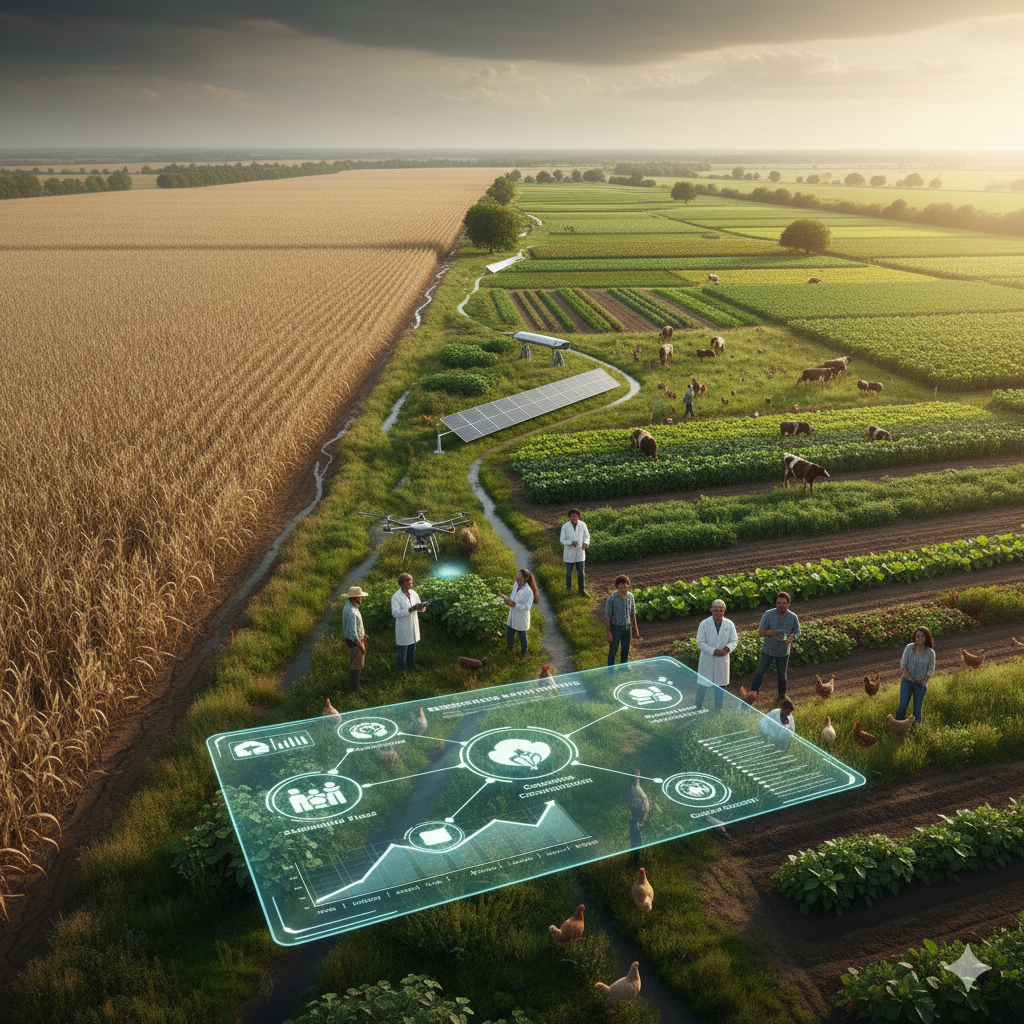
Regenerative farming is often portrayed as an idealistic alternative to conventional agriculture. However, it has major scientific, economic, and social foundations that make it a realistic and scalable path toward global food security, provided it receives sufficient investment, policy support, and innovation. Regenerative agriculture seeks to rebuild soil health, increase biodiversity, and reduce reliance on synthetic inputs like fertilizers. This method of farming creates a more resilient and sustainable food system. Some critics argue that yields may decline or that scaling such systems is impractical. Yet these objections overlook the major inefficiencies in modern agriculture and the potential that regenerative farming has. With the right structures in place, regenerative farming could feed the world sustainably while preserving the productivity of land for future generations. Having set the stage for this argument, we first explore the ecological foundations of regenerative agriculture, including how soil restoration, biodiversity, and carbon dynamics form the base. Then we move to questions of productivity and yield to assess whether regenerative systems can match conventional output. Next we consider economic viability, examining how regenerative practices fare economically for farmers and food systems. We then engage the skeptics’ case on scalability and standardization before offering a rebuttal that pushes toward optimism tempered with realism. Finally, we examine the social and cultural dimension, showing how regenerative agriculture offers not just ecological renewal but also community and farmer empowerment. We conclude by reflecting on the central question: can regenerative farming realistically replace traditional farming and feed the world?
(Gemini)
Reviving the Soil: The Ecological Foundation of Regenerative Agriculture
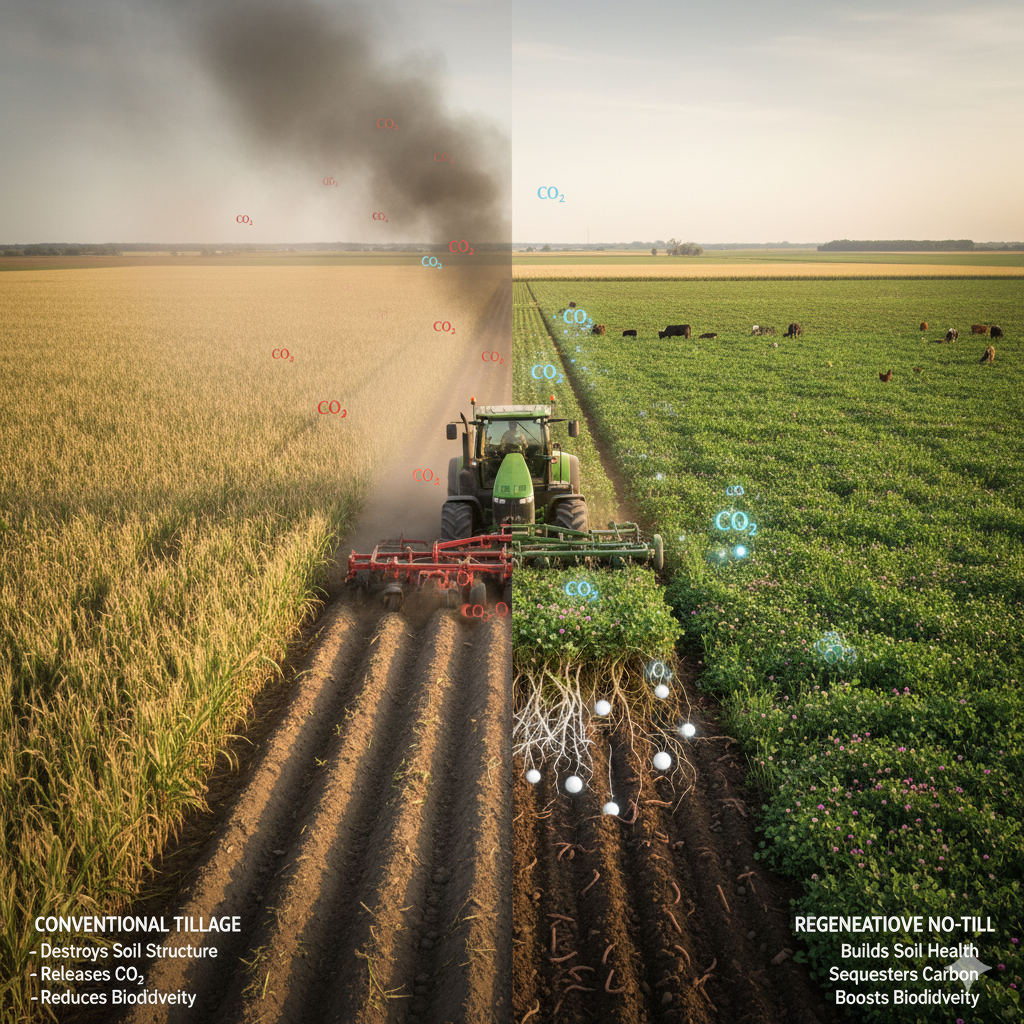
One of the most compelling reasons regenerative farming can replace conventional systems is in its focus on soil health. Healthy soil is the foundation of all food production, and regenerative agriculture works by rebuilding what industrial farming has eroded. According to EIT Food (2020), regenerative farming “increases biodiversity, enriches soils, improves watersheds, and enhances ecosystem services.” The organization emphasizes that it aims for ongoing improvement rather than static sustainability: “If you take care of your soil, it will take care of you” (EIT Food, 2020). Conventional farming practices, particularly intensive tillage which is the process of flipping and moving the soil around, monocropping, and heavy synthetic fertilizer and pesticide use, have made global soils much less healthy as these three things contribute to breaking up microbial communities, compacting structure, and releasing carbon dioxide into the atmosphere. As Ling (2022) explains, “Tilling soils exposes organic matter to oxygen, leading to the release of CO₂ that would otherwise remain locked underground.” In contrast, regenerative methods such as cover cropping, no till systems, and composting “keep carbon in the ground and allow plants to absorb more CO₂ from the atmosphere through photosynthesis” (Ling, 2022). Cover crops are especially powerful in this process. Fox (2025) notes that “Cover crops act like a sponge for carbon and nutrients, absorbing CO₂ instead of allowing it to escape into the air and improving soil fertility with every cycle.” The Chesapeake Bay Foundation also explains that “leaving soil covered year round with living plants reduces erosion, boosts water infiltration, and prevents nutrient runoff into waterways.” Beyond carbon sequestration, regenerative farming encourages complex soil biology. Mikołajczak (2022) highlights that practices like crop rotation, intercropping, and rewilding support microbial diversity, which in turn increases and plant resilience. Soil microbiomes are critical because they help plants access nitrogen and phosphorus more efficiently, reducing the need for synthetic fertilizers. Regenerative practices also store more water in the soil profile. Soils rich in organic matter can hold up to 20 percent more water, which buffers crops during droughts (Noble Research Institute, 2024). The ecological advantage becomes most visible in resilience. Healthy soils hold more water, resist erosion, and recover faster from droughts and floods. Furthermore, long term trials by the Rodale Institute, as cited by EIT Food (2020), found that “after a one to two year transition period, there is no difference between conventional and regenerative farming in yields, and in stressful conditions, this ability to bounce back stands out especially when temperatures rise and water’s hard to find, that’s where regenerative systems shine. Fixing soil so it acts like a real, breathing ecosystem shifts how farms connect with weather, rain, and wildlife, sparking a cycle that keeps giving: good earth grows strong plants, those plants then feed the ground right back. Bottom line? The environmental base of this farming approach holds up well. Instead of seeing dirt as something you use once, it sees it as alive, always changing. Rebuilding this system means regenerative farming doesn’t just halt dirt loss it sets up lasting harvests, better survival during droughts or floods, while supporting nature’s helpers like pollinators and clean water flow, things most regular farms skip. Since we’ve seen these methods can revive farmland health, the real puzzle remains can they grow enough food, year after year, to actually feed everyone on Earth?
(Gemini)
Productivity and Yields: Debunking the Myth of Lower Output
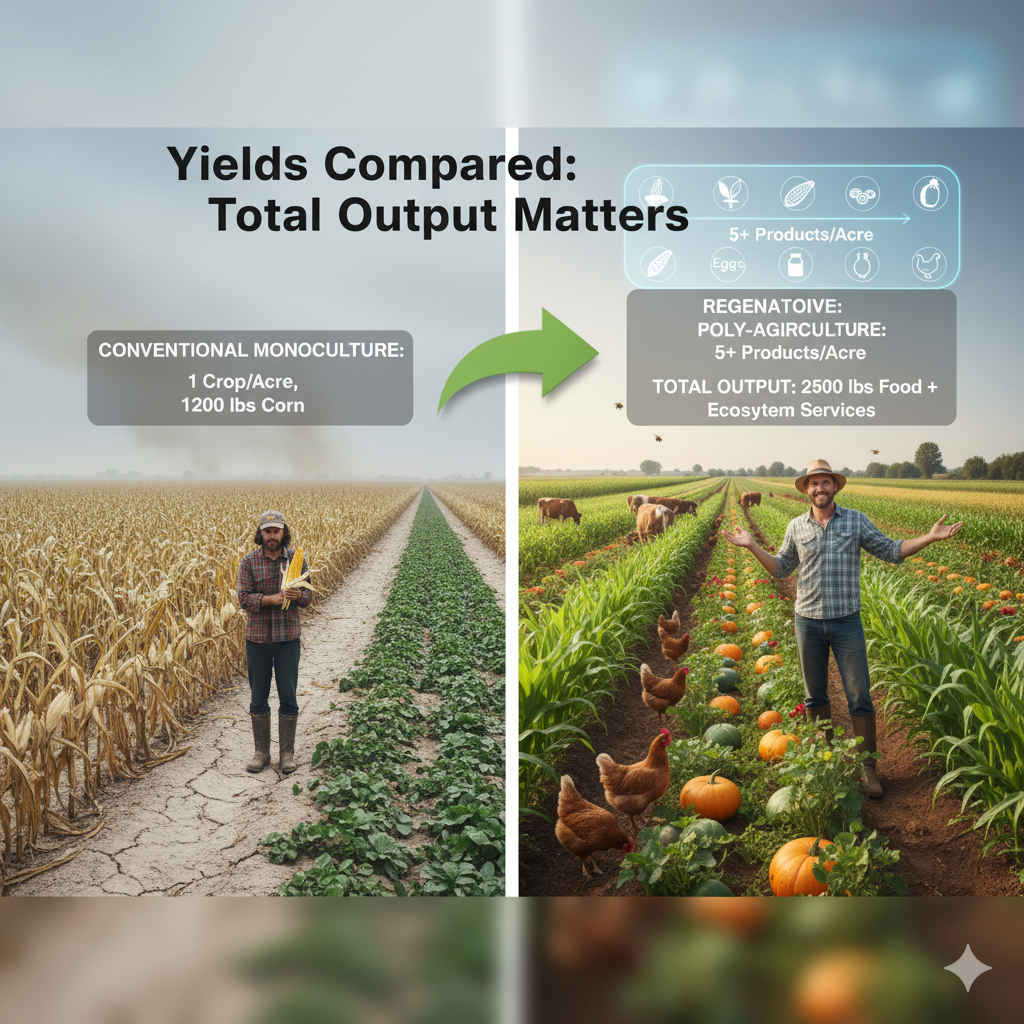
Critics often argue that regenerative farming cannot produce enough food to feed the global population. They say yields will inevitably decline when synthetic fertilizers and pesticides are reduced. This claim is not completely baseless: EIT Food (2020) acknowledges that “regenerative and organic methods can lower yields in some contexts, though the variation is large depending on crop types and local conditions.” However, this statement only captures short term trends. As soils recover and biodiversity improves, regenerative yields stabilize and often surpass conventional yields under stress. Indeed, the same EIT Food report quotes a practitioner saying, “After a 1–2 year transition period, when yields tend to decline, there is no difference between conventional and regenerative farming” (EIT Food, 2020). Moreover, yield alone is not the only measure of agricultural success. Regenerative systems emphasize total productivity what Ambokili Farm (2024) calls “total output per land unit.” The farm reports that “while regenerative farms may produce less of a single crop, their total output often surpasses that of industrial monocultures.” Polyculture systems and intercropping strategies yield multiple crops per acre, and when combined with integrated livestock, can significantly increase calories produced per hectare. While conventional farming practices solely focus on one crop per field, with regenerative practices there can be many crops in that one confined space. One Nature study found that “polyculture systems yielded 108% more food per unit area than monocultures” (Ambokili Farm, 2024). From an empirical vantage, meta analysis offers mixed but encouraging results. A recent Bayesian meta analysis of 195 paired observations in temperate arable systems found that regenerative practices improved soil organic carbon but did not consistently improve crop yields though importantly they did not reduce them either. Jordon et al. (2022) found that “none of these practices reduce yield during cropping years,” though they found “no evidence of a win–win between increasing SOC and enhanced agricultural productivity.” That means yields stayed stable rather than rose dramatically.This detail matters regenerative farming doesn’t always boost output fast when stacked against top conventional methods. Yet seeing no consistent drop in harvests weakens the claim that this approach always cuts production. Also, simulation studies hint that across areas hit hard by shifting weather, these techniques might lift crop results while also helping slow climate change. For instance, a modeling study in Nature Climate Change found that no till plus legume cover crops could create “win win” scenarios in regions such as Africa, Latin America, the US Corn Belt and North China Plain. Another dimension: agricultural productivity is not just about per crop yield but about nutrient density, multiple cropping cycles, improved ecosystem services, and reduced losses. For example, studies suggest regenerative farms deliver higher levels of micronutrients, phytochemicals and healthier food (Feliziani et al., 2025). The implication is: if regenerative systems maintain or slightly reduce yield but improve nutritional output, resilience and ecosystem services, their net value may be higher than conventional systems. Furthermore, regenerative agriculture shifts the framing from simply “tons per hectare of one crop” to “calories produced plus ecosystem services per hectare per year.”This wider view counts when wondering whether regenerative farming can truly feed everyone. When diverse crops, animals on the same land, and healthy soil come together, farms handle surprises better making results steadier over time. So even though some argue this method grows less food, which isn’t totally off base, more findings now point elsewhere: these techniques often keep yields stable, especially where normal methods struggle or fail. In other words: the yield argument does not collapse the regenerative case. Transition periods and context sensitivity remain crucial caveats, but the productivity threshold needed for global food security is not inherently precluded by regenerative systems. In transitioning to the next section, consider: if ecological foundations are solid and yields are at least comparable, how about the economics? Can regenerative farming offer a viable business model for farmers and food systems?
(Gemini)
Economic Viability: Regeneration as a Profitable Model
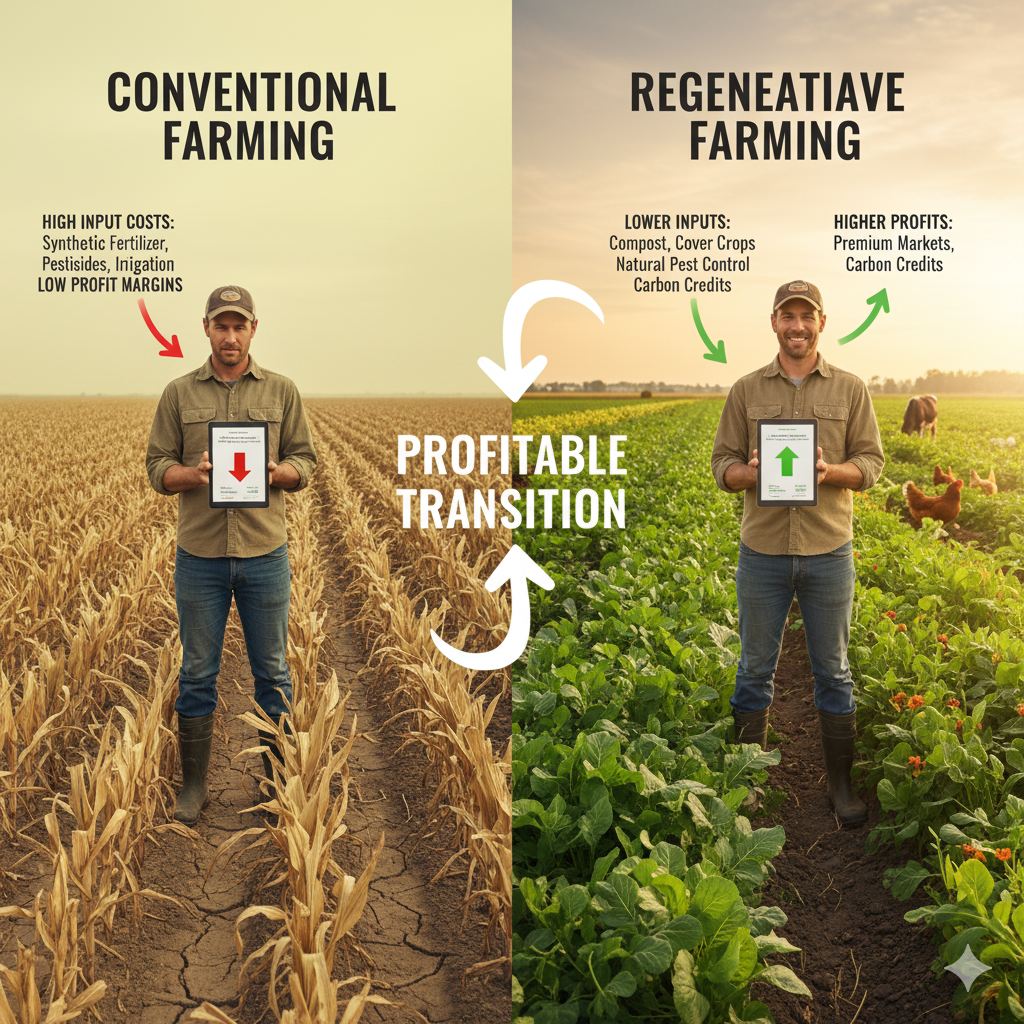
Beyond ecological benefits, regenerative farming is also an economic opportunity. As EIT Food (2024) observes, “Regenerative agriculture can be significantly more profitable for farmers because it lowers input costs and increases soil productivity over time.” The Rodale Institute’s trials showed that regenerative systems “had comparable yields but higher profits due to reduced inputs and organic price premiums” (EIT Food, 2020). This matches what farmers say: Ambokili Farm (2024) claims “farmers practicing regenerative methods often report lower costs of fertilizer, irrigation, and pesticides, while gaining access to new markets and sustainability premiums.” Savings happen because they rely on compost, ground covers, natural pest checks, or low-disturbance farming instead of costly lab-made inputs. On top of that, these farms tend to need less irrigation after their soil holds more moisture or fewer sprays once insects balance out naturally. Eventually, it gives them an edge. However, profitability depends on consumer demand and institutional support. Morrison (2024) identifies a key barrier: “Consumers associate regenerative farming with positive outcomes, but this doesn’t always translate into willingness to pay.” Without reliable market rewards, farmers may not risk transitioning. That’s where government policy, corporate procurement, and carbon credit markets can become essential. For example, the “Navarra 360º” project in Spain invests €3 million over three years to help 80 farmers reduce pesticide use by 20% and mineral fertilizer by 40%, while tracking over 60 sustainability indicators. It aims to “remove system level barriers to adoption” by offering “viable short and long term business models for farmers.” (EIT Food, 2024). Similarly, corporate supply chains and carbon credit frameworks are emerging: if a farmer can receive a payment for sequestering carbon or delivering ecosystem services (water retention, biodiversity), then the regenerative system has another revenue stream. As Farmonaut (2024) writes: “Regenerative agriculture isn’t charity it’s a new business model that rewards stewardship rather than extraction.” Importantly, economic viability is not just about individual farm profits it’s about systemic resilience and long term returns on investment. Conventional systems may deliver high yields short term but at the cost of soil degradation, declining fertility, higher externalised costs like erosion, nutrient runoff, climate adaptation. Regenerative farming flips that equation by internalising sustainability and resilience: the land becomes a productive asset rather than a depreciating one. That said, several economic constraints remain: transition costs such as equipment change, training, redesigning cropping systems, short term yield dips, market risks, and lack of standard certification or proven markets for “regenerative” branded produce or ecosystem services. Still, once you factor in all the hidden expenses of regular farming like environmental damage and risks from extreme weather the benefits of switching to regen methods start making more sense. Bottom line? It’s not just good for nature; it also stacks up financially. Cutting back on costly supplies, building tougher farms, while opening doors to fresh income streams helps move things away from take-take-take toward give and renew approaches. Still, pulling this off widely means reshaping rules, sparking smarter markets, plus backing farmers every step. With economics in mind, we now turn to the core concern: scalability and the skeptics’ case.
(Gemini)
Counterarguments: The Skeptics’ Case
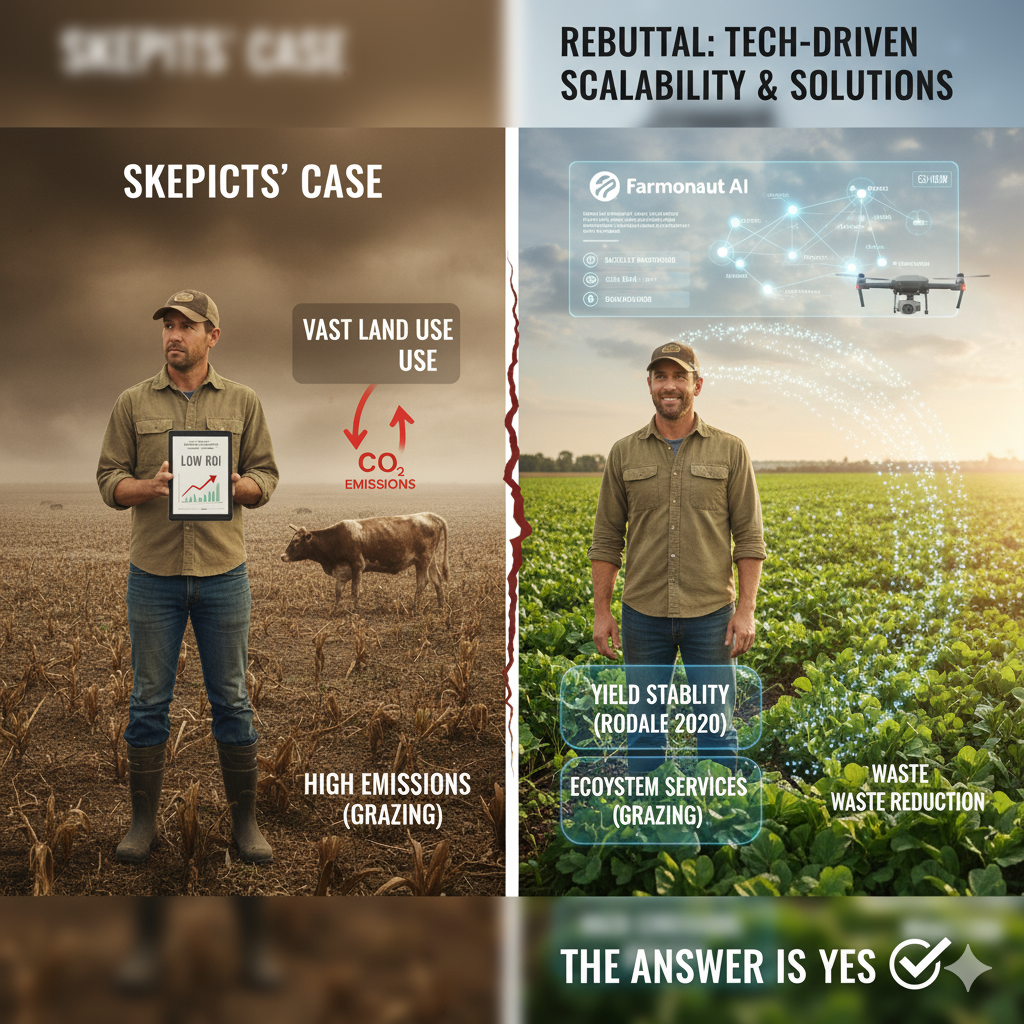
They say regenerative agriculture is a nice idea, but it cannot feed a world of eight billion people. Critics like Mishler (2023) argue that “research shows it can boost soil health and in some cases be profitable, yet proponents often promise far more than this type of farming can deliver.” She also warns that some forms of regenerative grazing “require vastly more land and may still produce significant emissions.” Another common criticism is that regenerative methods are hard to standardize and measure. Without clear definitions, “regenerative washing” can occur companies may market products as regenerative without proof. Dr. Bronner’s (2024) cautions that “creating a strong definition for the term ‘regenerative’ is crucial to avoid diluting its meaning.” Another major critique is scalability. The Noble Research Institute (2024) notes that “many regenerative practices are context specific and not easily transferable between regions.” Transition costs, skill requirements, equipment change, and labor intensity can act as barriers for many small farmers already operating on tight margins. If farmers face yield dips during the transition period and have no market premium, switching can be risky. Furthermore, modelling research suggests trade offs between yield and climate or ecosystem benefits. As one article summarises: improved soil management primarily supports either greenhouse gas mitigation OR higher crop yields but not always both simultaneously (Nature blog, 2024). Also, a considerable meta analysis found that while soil organic carbon increased, crop yields did not reliably go up (Jordon et al., 2022). Another scalability concern: global food demand continues to rise to a projected 9–10 billion people by 2050, and rising affluence is pushing up demand for meat, dairy and processed foods all of which place high resource burdens on any farming system, regenerative or otherwise. Some commentators say that unless regenerative agriculture is paired with dietary shifts, waste reduction and land use change, it cannot on its own “feed the world”. Lastly, the institutional and policy architecture is weak. Adoption of regenerative practices at scale requires extension services, farmer networks, certification systems, financial incentives, supply chain alignment and measurement frameworks. Without these, uptake remains patchy and slow thus limiting the real world impact. In short: the skeptics raise valid concerns yield uncertainty, land use trade offs, definitional ambiguity, transition risk, context specificity and institutional barriers. Rather than dismissing them, a credible argument for regenerative farming must address these head on. The next section does exactly that.
(Gemini)
Rebuttal: Why Regenerative Farming Can Still Feed the World
While the skeptics raise valid points, their arguments often rest on outdated assumptions about what defines productivity and scalability. Modern regenerative systems are not primitive they are data driven, tech enhanced, and supported by global networks of innovation. For example, EIT Food (2024) is already implementing “landscape scale programs that combine satellite monitoring, farmer training, and corporate co funding to enable mass adoption.” Digital platforms like Farmonaut (2024) use remote sensing to track soil carbon and water retention, helping farmers quantify and sell ecosystem services. In response to concerns about land use trade offs, recent research (Mikołajczak, 2022) found that many farmers view “rewilding and regenerative land management not as opposites, but as complementary processes that enhance ecosystem and production outcomes.” This suggests that farmers themselves see regenerative systems as practical, not idealistic. As for yield, the Rodale Institute’s findings (EIT Food, 2020) remain powerful evidence. “After a 1–2 year transition, regenerative yields equal conventional yields, and in drought years outperform them.” That is not theoretical it is empirical. The meta analysis caveat (Jordon et al., 2022) is worth acknowledging, but it does not refute the case; rather it highlights the need for local adaptation, longer time horizons and more integrated systems (diverse crops + livestock) rather than simple monoculture swaps. Further, the global picture of food demand and supply is not static. It is increasingly clear that feeding the world is not simply a matter of producing more tons of commodity crops; it involves reducing waste (currently ~30% of global food production), shifting diets especially reducing resource intensive meat consumption, and increasing nutritional density rather than just calories. As Ling (2022) puts it, “The world doesn’t need to produce more food; it needs to produce food more wisely.” Thus regenerative agriculture does not need to double yields to “feed the world” it needs to improve the efficiency, resilience and nutritional quality of food systems. Complementing this, institutions such as the Food and Land Use Coalition (FOLU) in its January 2023 report argued that implementing specific regenerative agricultural practices has the potential to fit within a reform agenda without requiring large scale land conversion. (Food and Land Use Coalition) In other words: it is not regenerative agriculture alone that will feed the world but regenerative agriculture within a broader food system transformation including waste reduction, dietary shifts, efficient protein sources, circular nutrient flows that together can realistically meet global food needs. There are also examples of scalability. The World Economic Forum (2023) outlines “5 ways to scale regenerative agriculture” including making it commercially attractive, prioritizing farmers as key players, leveraging technology, building measurement and data systems, and innovative financing. These aren’t just ideas they’re showing up in actual farms today. Still, new tools like satellite tracking, smart farming gear, or AI-powered checks help make regenerative methods work better and across wider areas than before. To put it simply, if we ask straight-up: “Is it possible for regenerative farming to take over regular farming and feed everyone? Yes but with conditions: Those conditions include: policy and financial support, farmer training and networks, supply chain re orientation, consumer demand alignment, measurement frameworks, and inclusion of diversified, integrated systems not just simple monoculture swap outs. When those structures are in place, the regenerative path is not utopian it is plausible.
The Social and Cultural Dimension: Empowering Farmers and Communities
Regenerative farming isn’t just healing soil health, it’s people healing too. It is rebuilding independence for growers, and creating a stronger sense of community for farmers. Ambokili Farm (2024) describes it as “a whole ecosystem approach where the farm, community, and individuals grow together.” By reducing dependency on external inputs (fertilizers, pesticides, seed companies) and global supply chains, regenerative farmers regain control over their livelihoods. As Iram (2025) explains, “Regenerative systems re embed agriculture in local ecosystems and economies, allowing farmers to become caretakers rather than extractors.” This philosophy matters because sustainable change requires cultural buy in. The Noble Research Institute (2024) stresses that “regenerative agriculture is a mindset shift as much as a management change it means thinking in terms of cycles, not seasons.” The social side includes fair access, small farmers in poorer regions often deal with worn-out soil, loans they can’t repay, or sudden weather disasters. Instead of worsening things, better farming methods may boost yields, lower spending on supplies, while helping farms survive heavy rains or dry spells. On top of that, local groups, shared knowledge, guidance from experienced growers, along with team-run farms play a growing role in shifting toward these sustainable approaches. For example, the FOLU report (2023) emphasises that scaling requires “inclusive governance, farmer participation and livelihoods.” (Food and Land Use Coalition) These networks also enable knowledge sharing across regions and contexts, reducing the barrier of “context specificity”. There is also a cultural narrative: regenerative farming reframes the farm ecosystem community relationship, moving away from extraction and toward restoration. This has psychological, emotional, and cultural benefits for farmers and rural communities benefits that often go uncounted in traditional agricultural economics. A move toward care instead of overuse might slow down emptying villages, unused fields, or giant single-crop operations that usually weaken local bonds. So, human ties and traditions aren’t side issues they’re key. Picture growing food through renewal methods, then picture the growers themselves, the towns standing behind them, plus the shared beliefs making such shifts possible. Farming like this opens doors not just to better soil and harvests but also to stronger incomes for farmers, livelier country areas, and greener neighborhoods.
Conclusion: Feeding the World by Healing It
Regenerative farming isn’t some far-off fantasy. It’s actually doable, a practical way to grow food for everyone. Instead of fighting nature, this method fixes damaged soil, pulls carbon from the air into the earth, while boosting diverse life on farms. That means crops stay reliable year after year, all while helping slow climate change. Some say these farms won’t make enough to feed people, yet newer studies plus actual farm results prove otherwise given patience and help, they can equal or beat regular farms in output. The reality? Switching to regenerative agriculture needs time, work, because it demands upfront commitment yet the benefits pay off down the road. Stick with old-school techniques wrecking dirt, boosting emissions, so we’ll burn through nature’s basics needed to grow meals. This kind of farming offers a path ahead one keeping bellies full now while guarding farmland later on. More than just another crop strategy, it’s proof we’re able to raise food repairing the planet instead of breaking it. As global pressures on food systems grow, approaches that strengthen both the land and farming communities will become increasingly essential. Regenerative agriculture shows that sustainability and productivity don’t have to be opposites—they can grow from the same healthy soil.
EIT Food. (2020, August 25). Can Regenerative Agriculture Replace Conventional farming? – EIT Food. Www.eitfood.eu. https://www.eitfood.eu/blog/can-regenerative-agriculture-replace-conventional-farming
Tonny. (2024, October 2). Can Regenerative Farming Feed the World? – Ambokili Farm. Ambokili Farm – Preserving Biodiversity, Inspiring Change. https://ambokili.farm/can-regenerative-farming-feed-the-world
Mishler, J. (2023, September 8). The Promises and Pitfalls of Regenerative Agriculture,
Regeneration International. (2015). Why Regenerative Agriculture? – Regeneration International. Regeneration International. https://regenerationinternational.org/why-regenerative-agriculture/
Ling, M. (2022, August 17). Can regenerative farming save our food and future? Adventure.com. https://adventure.com/can-regenerative-farming-save-our-food/
Regenerative Agriculture. (n.d.). Www.cbf.org. https://www.cbf.org/issues/agriculture/regenerative-agriculture.html
Morrison, O. (2024, July 12). The 6 problems you get from asking consumers about regen ag. AgTechNavigator.com. https://www.agtechnavigator.com/Article/2024/07/12/Six-problems-with-regenerative-agriculture/
Farmonaut. (2024, December 11). Revolutionizing Agriculture: How Regenerative Practices Are Reshaping Sustainable Food Production in North America. Farmonaut®. https://farmonaut.com/usa/regenerative-agriculture-5-ways-it-transforms-food-production
Fox, A. (2025, July). What are the Benefits of Regenerative Agriculture? Friends of the Earth. https://foe.org/blog/what-are-the-benefits-of-regenerative-agriculture/
Noble Research Institute. (2024). Regenerative Agriculture. Noble Research Institute. https://www.noble.org/regenerative-agriculture/
Mikołajczak, K. (2022). Rewilding—The farmers’ perspective. Perceptions and attitudinal support for rewilding among the English farming community. People and Nature. British Ecological Society.
Iram, F. (2025). View of Vol. 1 No. 1 (2025). Theccar-Journal.org. https://theccar-journal.org/index.php/AAR/issue/view/1/1
FAO (Food and Agriculture Organization of the United Nations). (2023). Soil health and carbon sequestration for sustainable food systems. https://www.fao.org
UNEP (United Nations Environment Programme). (2024). Regenerative food systems and climate resilience. https://www.unep.org
World Resources Institute. (2023). Creating resilient food systems through regenerative agriculture. https://www.wri.org
USDA. (2024). Regenerative agriculture and soil carbon programs. U.S. Department of Agriculture. https://www.usda.gov